Showing posts with label Pasta. Show all posts

Friday, January 8, 2016

Pasta Carbonara

This recipe was a necessity for me to learn, since my husband ate Carbonara every day during our honeymoon in Italy. I copied down the recipe used by La Carbonara in Rome, from a travel show I was watching one day. I have altered it to my own taste. The traditional Carbonara is made with spaghetti, but I have never liked the texture of spaghetti and am not enough of a slave to tradition to make this recipe with it. I have also added more cheese and eggs for a creamier taste without resorting to using cream. Fettucine is pictured here: 
Ingredients: 


1 lb linguine or fettucine
5 eggs, 2 whole and 3 extra yolks
1/3 lb pancetta cut into a small dice
Freshly ground black pepper corns
3/4C Romano Cheese
3/4C Parmigiano


Directions: 
While you are boiling the water for the linguine, slice, dice and saute the pancetta until it's lightly browned on the edges. If pancetta is unavailable, you can substitute a lean non smoked bacon, but do attempt to find panchetta, as it is a better tasting product. Better yet, use guanciale, the traditional Italian ingredient. Then lightly drain off the fat and set aside. The point to sauteing the pancetta is to render the fat, not to make it very crisp.

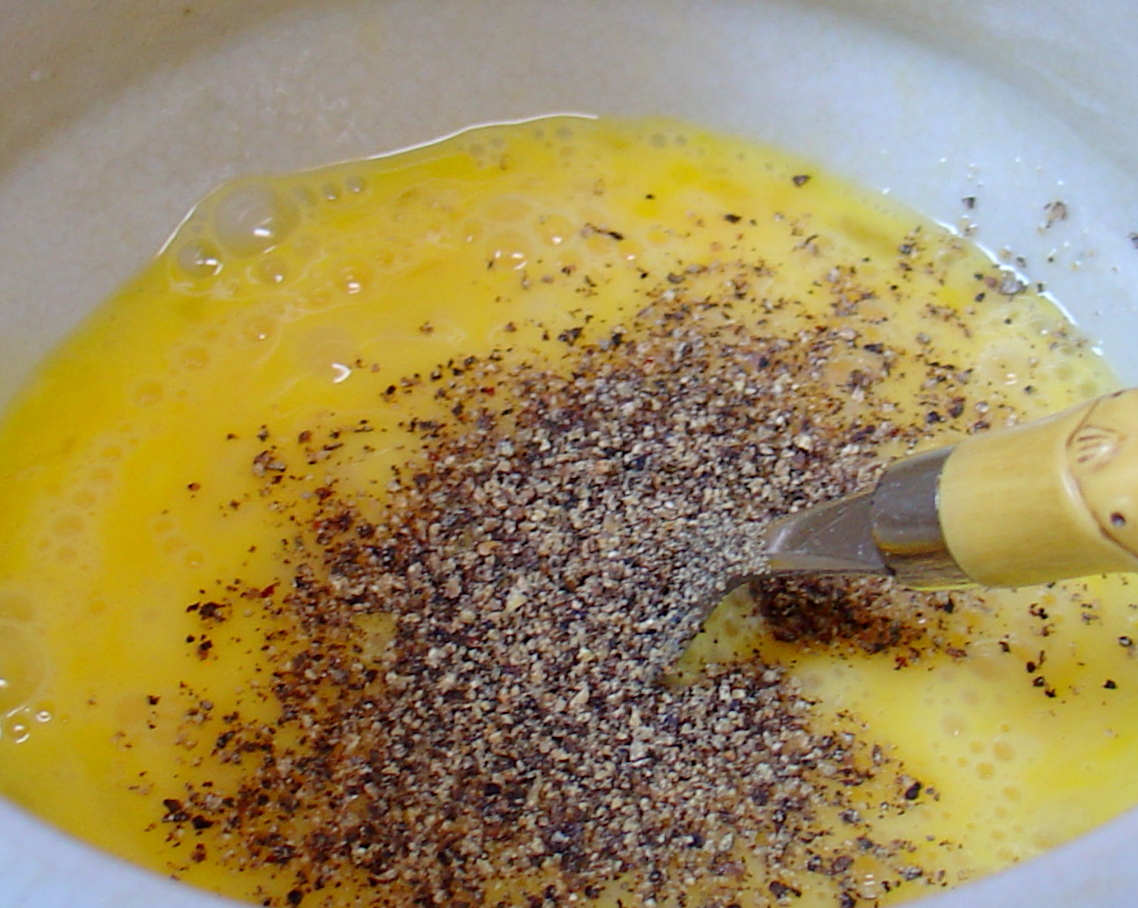
Place the shelled eggs and extra yolks into a small bowl and beat until well blended. Grind the fresh black peppercorns into a medium courseness, then add and beat into the eggs. Set the bowl aside, with the grated cheese and mix them together just before adding to the drained pasta.



As soon as the linguine is al dente, drain the pasta and take a cup of the pasta water and set aside. Turn off the heat, and place the pancetta into the bottom of the empty pasta pot, and proceed to add back the pasta, then stir them together. Now add the cheese into the bowl with the egg and mix to combine them. The pot will be hot from the boiling water and that residual heat is what will cook and thicken this egg sauce. Pour the egg and cheese mixture over the pasta and stir quickly to create the thickened sauce.


Use a little of the reserved pasta water, if necessary to help the cheese to melt and the egg to become creamy. Use 1T at a time, only if the pasta looks dry and is difficult to stir. Adding too much will ruin the recipe; adding too little can easily be adjusted. This particular making of the recipe did not require any of the pasta water at all. The last photo clearly shows that the cheese had melted and the sauce was already creamy.
If you have failed to turn off the heat, you will have scrambled egg pasta, not Carbonara.

Monday, February 2, 2015

Pasta Frittata

DSC07071
Ever since I heard that Italians made a frittata with leftover pasta I’ve been wanting to try one. Nonna ate plenty of leftover pasta for breakfast, and Nana reheated pasta all the time with a tiny bit of water to keep it from drying out, but neither of them ever mixed it with an egg, nor had they fried it in olive oil.
DSC07061DSC07064
For more years than I can remember, we never accumulated leftover pasta. But now, I find myself not eating portions as large as they used to be, so on this occasion the leftovers were available, although there wasn’t a large amount. I had about a cup of leftover perciatelli, that is a bit wider than spaghetti, made with my standard meat sauce and sprinkled with Pecorino Romano cheese, so I mixed it a little at a time with 3 extra large eggs.
DSC07066 
I heated a non stick frying pan with a little extra virgin olive oil and brought it to a medium temperature, then added the egg and pasta mixture. I lowered the heat slightly and when the edges looked brown, took a peek underneath to see of it looked ready to turn over. With a spatula I did turn over the frittata.
DSC07069
It was a beautiful golden brown, so I cooked the 2nd side to match, then plated the entire thing. This dish could work very well as part of a brunch menu.

Wednesday, April 30, 2014

Vegetable Pesto Lasagne

DSC07224

For years I've been thinking about trying to make a green vegetarian lasagne and this  Easter I finally gave it a go. I wasn't certain whether either the broccoli or zucchini would be flavorful enough on their own, so I used  both of them and for even more flavor I added pesto to the mix. This was then layered with béchamel, because a tomato based sauce would certainly overpower the already delicate flavors.

Ingredients:
1 box flat lasagna sheets
2 small heads of broccoli
3 medium zucchini
2C chicken broth (or sub vegetable)
2T olive oil
3T butter
4T pesto
salt & pepper to taste
2C freshly grated parmigiano
2C coarsely grated Pesto Gouda
1C ricotta
1 egg
1T minced parsley
3C béchamel sauce
     4T butter
     4T flour
     3C whole milk
     grated nutmeg to taste


DSC07158DSC07162  
After putting the raw broccoli into the food processor, I blanched it in the chicken broth so the color would stay bright green. After draining the blanched vegetable I added 2T of thawed pesto that I had made ahead of time and frozen. Both salt and pepper were added to boost the flavor.

DSC07176DSC07165 
Since the zucchini was more delicate in  both texture and flavor, it was shredded and sautéed in butter, with a little olive oil to keep it from smoking, while I did a quick sauté. Pesto was again added after draining.

DSC07186
Next came the ricotta mixed with the egg and parsley. In truth, I think skipping this layer would actually improve the dish, so I plan on eliminating it next time I try this lasagne. However, it has inspired the idea to try a ricotta pesto lasagne with a tomato based sauce.

DSC07187DSC07190
A large pasta pot was being filled with water and brought to a boil. Before the béchamel was started, 4 pasta sheets were added and boiled until tender. If I have noticed anything about Italian cooking in Italy, it is that lasagne  is never served al dente like other pasta. The sheets were taken from the pot with tongs, so they could drain and be placed on a cotton dish cloth. When waiting for the pasta to cook, you can grate the cheese.

DSC07179DSC07181
Next came the béchamel. Butter was added to a pan and melted at a low heat. After adding the flour and whisking the two ingredients together, the heat was raised to medium temperature, while the raw flour was being cooked for a few minutes, just short of turning color. The milk was then slowly whisked into the mixture and the whisking continued until the béchamel thickened to a more than heavy cream stage. Freshly grated nutmeg was added when the heat was turned off and the pot was covered to prevent a skin forming on the sauce.

DSC07194
The lasagna dish was buttered and the first layer of pasta went on the bottom; a layer of vegetable, in this case zucchini, was added next, along with a light layer of the grated pesto cheese.

DSC07197
A layer of béchamel and a light layer of parmigiano were added.

DSC07199DSC07203
More pasta, was added with a thin layer of the ricotta mixture and some of the shredded pesto gouda.
DSC07205DSC07207DSC07208
Layers of pasta and broccoli with the pesto gouda, along with béchamel and parmigiano  were alternated with the zucchini and ricotta layers, until the pan was filled. The last layer was merely béchamel and parmigiano.

DSC07221
The completed lasagne was placed into a 325 degree preheated oven for about an hour. The top layer browned nicely and let me know when to take it from the oven, although technically I just turned off the oven and left it inside, since other components of the meal were still in need of some attention.

Vegetable Pesto Lasagne Leftovers

DSC07210
While I might never make this dish on its own, it was good enough to serve to guests. After making the components of the vegetarian lasagne and assembling it, it was very clear that I had made much more than needed.
DSC07211 
Since I had pasta left over it seemed a good idea to try and use the other leftover ingredients for a pasta dish, so I cut up the pasta sheets, folded in some of the broccoli and bechamel sauce, then some of the shredded pesto Gouda, and microwaved it until the cheese melted. A quick stir and a sprinkling of parmigiano sealed the deal!

Monday, June 4, 2012

Pesto Macaroni and Cheese

After making my first macaroni and cheese, it seemed like a good idea to expand on this theme and see what I could come up with.DSC01931

Ingredients:

1 lb. macaroni
1/3 flour
1/3 cube butter
2C whole milk
12 oz. mixed Italian cheeses
2T pesto
Panko crumbs
basil flavored extra virgin olive oil

Directions:

DSC01898DSC01902DSC01906 

Start the sauce by melting the butter in a large sauce pan over low heat and adding the flour. Your object is to cook the raw flour but not to brown it.  Add the milk and whisk briskly so no lumps form. Then you may add the cheese.

DSC01912

Cook the pasta in boiling water until it is tender, not al dente. I have never had a good baked pasta that was al dente, nor has it ever seemed overcooked. save a cup of the water while draining the pasta. you may need it to thin down the cheese sauce.

DSC01910DSC01913DSC01916DSC01919DSC01921

Slowly melt the cheese into the bechamel sauce, then add  some of the pasta water to thin it out. You want it to be able to cover the pasta evenly and to have enough liquid to cook it a bit more. Add one tablespoon of pesto. Taste, and if you want a stronger flavor add more. At this time, you could also add salt and pepper, if you felt it necessary.   

DSC01922DSC01925DSC01924

Mix the sauce into the pasta, place in a buttered baking dish and bake at 350 degrees for 30 minutes.  While the pasta is baking, take the bread crumbs and saute them in the basil flavored olive oil. You may like to add a small amount of salt, but I didn't bother to do that. If you do add a very small amount, taste, then adjust to your liking.

DSC01933